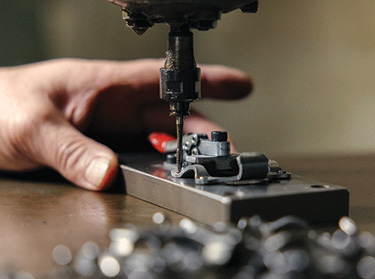
Where Secondary Operations Start To Control The Real Program

Use this page when the part itself is only one step in the finished production path and the real questions are about welding, insertion, assembly handling, or downstream integration.

It keeps that broader program-support discussion off the shorter parent page while still giving buyers and engineers the detail they need.

Secondary operations and assemblies support for formed metal components

Where This Capability Usually Enters The Program

Not every component can be completed entirely within a single four-slide or stamping cycle. Many applications require additional operations to support assembly integration, mounting features, threaded hardware, welded structures, dimensional refinement, or functional subassemblies.

  • Assembly integration
  • Mounting features
  • Threaded hardware
  • Welded structures
  • Dimensional refinement
  • Functional subassemblies

Main Capability Page

Use the main capability page for the shorter overview and direct quote path.

What Buyers Usually Need To Clarify Before Review

Assembly and value-added production support

Single-head and multi-head resistance welding systems support applications requiring welded brackets, studs, tabs, contacts, or attached hardware.

These operations are commonly used where structural integrity matters, electrical conductivity is required, attached features improve assembly efficiency, or multiple formed components must function together as a complete assembly.

  • Secondary Forming & Press Operations
  • Welded Assemblies & Attached Hardware
  • Manual & Automated Assembly Methods
  • Packaging, Kitting & Sequencing
  • Inspection & Verification

Supporting Review Topics

Secondary operations may include staking, piercing, trimming, forming refinement, and added press work where the finished component requires more than the primary forming cycle.

Resistance welding systems support brackets, studs, tabs, contacts, and multi-piece assemblies where structural integrity or electrical conductivity matter.

Depending on production volume and geometry, programs may use manual assembly, dedicated fixtures, automated equipment, or combinations of multiple assembly approaches.

Common Questions

Can secondary operations be integrated into four-slide production programs?

Yes. Depending on the application, secondary forming, welding, fastening, trimming, tapping, and assembly operations may be integrated into the broader production workflow.

What types of assemblies are commonly supported?

Programs may include welded assemblies, hardware-integrated components, formed subassemblies, threaded components, and customer-specific packaged assemblies.

Can assemblies be supplied production-ready?

Yes. Packaging, sequencing, kitting, and assembly preparation may be configured to support downstream production or line-side use.

Back To Capability Page

Need To Review Secondary Operations?

Send the assembly flow, secondary-operation needs, and production context so the support path can be reviewed directly.